
Formation of CONAIE
The Organization of Indigenous Peoples of Pastaza (OPIP) was founded in 1978 as a way of fighting the threats of colonization and oil exploration. The Confederacion de Nacionalidades Indigenas de la Amazonia Ecuatoriana (CONFENIAE) was founded in 1980 and encompassed various Indigenous nations. The highlanders and Amazonians became interrelated once officials from both sides met and discussed a plan to form a national confederation; this organization, that formed in 1986, was known as the Confederacion de Nacionalidades Indigenas del Ecuador (CONAIE). Their strategic power and influence have led to the freezing of economic activity and have even caused presidents to step down from their positions.
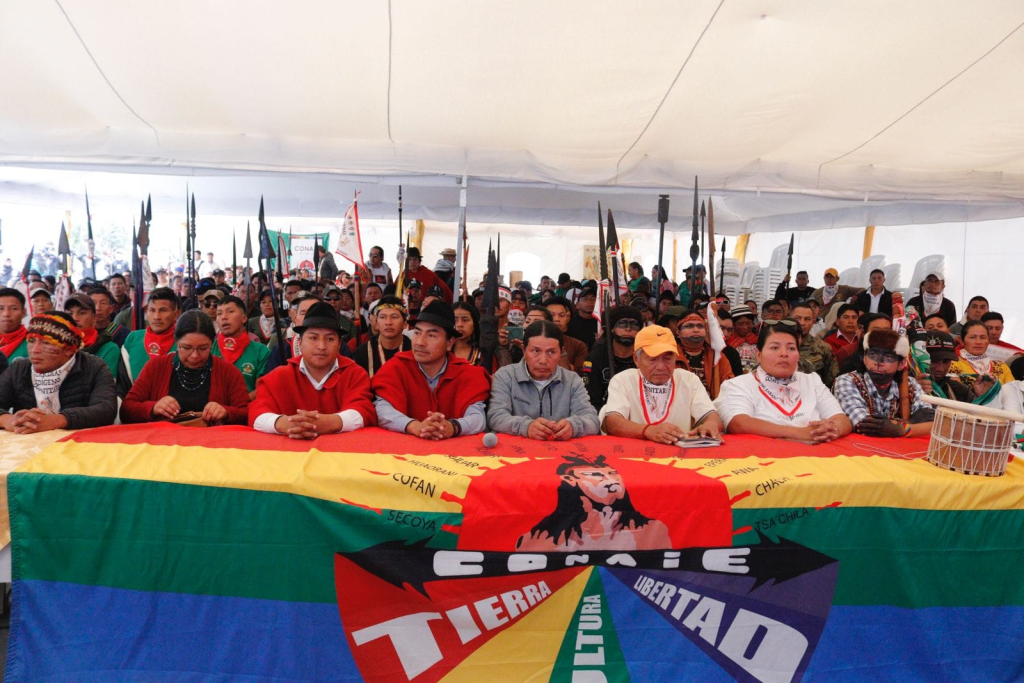
Indigenous communities scattered throughout Ecuador demanded for redistribution of wealth and land. There have been great inequalities suffered by Indigenous communities through the legacy of the hacienda economy, unequal land tenure, and debt peonage. The president at the time, Rodrigo Borja, campaigned against neoliberalism and was in support of multiculturalism. However, like many before him, he was unwilling to meet with indigenous populations to discuss the possibility of land reform. As one could imagine, Indigenous populations revolted and set up blockades. Many of CONAIE’s demands were never put into effect and sparked a tense period in Ecuador’s political scene.
New Era for Ecuador
Rafeal Correa’s Presidency
Rafeal Correa came into presidency in Ecuador in 2007. His government worked his political party, PAIS Alliance, which have carried out a profound political and institutional reform since 2007.
About PAIS Alliance
PAIS Alliance is a political party in Ecuador that was founded by the nation’s 45th president, Rafael Correa. The party found success amid the “pink tide” period in Latin America. The party’s early period in power (2007–2017) is known as the Correa era, as Correa was in the presidential office at the time.
Rafael Correa’s Term
As mentioned previously there are many indigenous groups and political affiliations that have had little to no leeway when determining how to escape poverty and inequality within Ecuador. Rafael’s government changed this.
James Petras and Henry Veltmeyer have conducted extensive research, and they found that from 1990 to 1999, the Ecuadorian government allocated just 6.4 percent of GDP to social spending. In stark contrast, during the start of Correa’s presidency, average social spending was 11.7 percent of GDP.
It is important to note that before this, Ecuador was under the IMF’s structure, and for two decades, it had to follow their adjustments. This pushed spending in the social sector and public investment to all-time lows. This is a great example of how external factors, like the world’s largest economic policy maker, can have negative effects on countries. Whether it is through ignorance or lining their own pockets, a nation’s people are the only ones who truly know what is best for them.

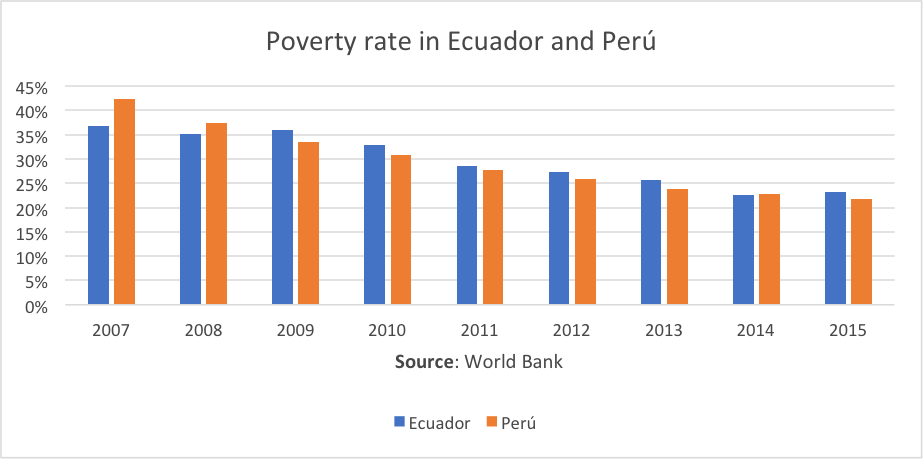
For many, policies set by the government is all it takes to make it one step closer to living a life that isn’t miserable. A report from ODI Global shows that “poverty measured by the national poverty line (which equates to about $2.80 a day) followed a similar pattern: it peaked at 75.1% in 1999 in rural areas and at 36.4% in urban areas, but then declined steadily, reaching 47.3% and 15.5% in urban areas by 2014 (Figure 1). There was also a reduction in chronic poverty: an INEC study found that it peaked with the crisis in 1999 (70% and 29% in rural and urban areas respectively), but had dropped to 36% and 10%, respectively by 2014 (INEC, 2014b).”
A statistic like that just goes to show how much effect the government has on its people. Some policies and social spending were all it took for many people to get out of poverty. Many of the rules and regulations set before this were set in a colonial and capitalist system that benefits from people being poor because they know they need the work to live. Rafael Correa was able to shift the tide for Ecuador and escape from the imperialist ideologies that the country was built on.
However, it wasn’t all sweet over in Ecuador, and even Correa did not always put his people before other interests. Petras and Veltmeyer took notice that the Ecuadorian government was trying to conserve 4 million hectares of forest, and by 2012, the Correa administration had signed fifty-seven agreements with peasant and indigenous organizations, and 574 individual agreements, for the conservation of 539,703 hectares. This all sounds great, but under the Social Forest and Social Moor programs, communities were pushed from their lands, and the program contracts forced them to become a form of forest ranger on their territories. “To expel the indigenous communities from their territories breaks their ancestral dynamic of harmonious coexistence with the earth and converts them into users of the land for a cash income, which in the long term impoverishes them.”
Pushing indigenous communities back to work because they have no other option is the founding idea of Spanish settlers whenever they first came to Ecuador. It just goes to show how easily laws can be created and manipulated to work in the favor of the nation’s elites.